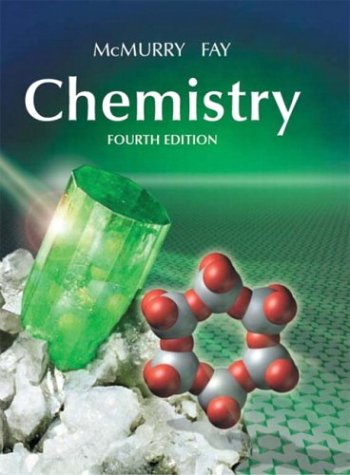
Chemistry, 4th Edition
Home/
Chemistry, 4th Edition
Chemistry, 4th Edition
No customer reviews yet
For full-year general chemistry courses taken by biology, premedical, science, and engineering majors. McMurry/Fay's Chemistry focuses on visualizing and thinking to achieve try understanding. The text teaches the basics of solving problems using its trademark clear discussions and new art-enhanced format. The text moves students beyond rote quantitative problem solving, encouraging them to visualize and think about a problem before beginning to solve it; it conveys the key concepts being discussed to help students truly understand the chemistry by using unique, proven features. The clean, interesting writing style talks directly to students with a minimum of distractions. Molecular illustrations are abundant and are placed where they are referenced for maximum effectiveness with students. Features McMurry and Fay present chemistry without burdening students with unnecessary distractions, all via a clear, consistent presentation. NEW - Updated throughout to reflect a comprehensive look at general chemistry and to further clarify the material for students??????????????????For example, the 4th edition includes coverage of zero-order reactions. NEW - More Worked Examples??????????????????Provide explicit, detailed solutions showing students how to formulate a strategy for solving the exercises along with step-by-step instructions for arriving at an answer. NEW - Revised Worked Example Format??????????????????Enhances student comprehension. NEW - Illustrated Two-Column Worked examples??????????????????Presents the mechanics of a problem and an explanation of those steps in a unique fashion. The concept is enhanced by the inclusion of a pertinent visual illustration, molecular model, or photograph. NEW - Worked Key Concept Problems??????????????????Literally show students how to solve conceptual problems and come up with the picture that a chemist sees. Visual Key Concept Summaries??????????????????Added after the narrative Summary at the end of each chapter. Understanding Key Concepts Problem Sets??????????????????Appear at the beginning of the end-of-chapter problem sets. NEW - More General and Multi-Concept Problems in the end-of-chapter problem sets. e-Media Problems??????????????????Based on the Student Tutorials and Activities on the standard and premium Companion Websites. NEW - Additional Molecular Art??????????????????Newly rendered ball-and-stick and space-filling models accompany structural formulas to make molecular geometry clear. NEW - Twice as many Macro-to-Micro Illustrations??????????????????Juxtaposes photos with illustrations to depict processes on the molecular level. NEW - Electrostatic potential maps??????????????????Provide a striking visual representation of calculated electron distribution in molecules. Contents Chemistry: Matter and Measurement. Atoms, Molecules, and Ions. Formulas, Equations, and Moles. Reactions in Aqueous Solution. Periodicity and Atomic Structure. Ionic Bonds and Some Main-Group Chemistry. Covalent Bonds and Molecular Structure. Thermochemistry: Chemical Energy. Gases: Their Properties and Behavior. Liquids, Solids, and Phase Changes. Solutions and Their Properties. Chemical Kinetics. Chemical Equilibrium. Hydrogen, Oxygen, and Water. Aqueous Equilibria: Acids and Bases. Applications of Aqueous Equilibria. Thermodynamics: Entropy, Free Energy, and Equilibrium. Electrochemistry. The Main-Group Elements. Transition Elements and Coordination Chemistry. Metals and Solid-State Metals. Nuclear Chemistry. Organic Chemistry. Biochemistry. Appendix A: Mathematical Operations. Appendix B: Thermodynamic Properties at 25?????????C. Appendix C: Equilibrium Constants at 25?????????C. Appendix D: Standard Reduction Potentials at 25?????????C.
About the author
Product details
ISBN-100131402080
Contents same as book with ISBN0131402080
Last updated 2016-09-01 18:17
Price unavailable
This title cannot be purchased online right now — check back soon.
In stock soon — order now to reserve your copy
Delivery by Monday, September 7, 2026
Not available to order
Sign in to Add to Saved list
Free delivery on orders over $35.
15-day returns. Any reason.
Secure checkout. We never store card details.
Readers who bought this also bought
More from MP_ALL