
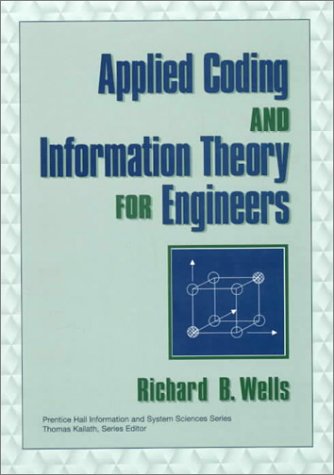
Applied Coding and Information Theory for Engineers, 1/e
Home/
Applied Coding and Information Theory for Engineers, 1/e
Applied Coding and Information Theory for Engineers, 1/e
No customer reviews yet
Intended for use in an undergraduate course, this book provides a practical introduction to the theory and practice of coding and information theory for applications in the field of electronic communications. It is written at an introductory level and assumes no prior background in coding or information theory. While the mathematical level is detailed, it is kept at an introductory level. Features Presents the theory and practical applications of coding and information theory integrated with detailed examples which illustrate key concepts and enlarge the theory. Every major section of the text includes at least one example of a design-oriented problem where the theory is applied. Required mathematical developments immediately precede material on ????????????????how to??????????????? apply the methods and theory, however the traditional theorem-proof format is not used. Presents an overview of digital communication systems and the concept of information. Introduces discrete information sources and the fundamental concepts of entropy and data compression codes. Includes a brief introduction to the application of information theory to cryptography. Written in a easy-to-follow conversational style that integrates practical engineering issues through formal and conceptual discussions of mathematical issues. Makes extensive use of explicit examples that illustrate the methods and theory throughout the text. Homework exercises at the end of each chapter include exercises which reinforce the material in the text. Also provides additional exercises which pose more challenging questions, helping students to see how the theory extends to more general situations. Contents Discrete Sources and Entropy. Channels and Channel Capacity. Run-Length-Limited Codes. Linear Block Error-Correcting Codes. Cyclic Codes. Convolutional Codes. Trellis-Coded Modulation. Information Theory and Crptography. Shannon's Coding Theorems.
About the author
Product details
ISBN-100139613277
Contents same as book with ISBN0139613277
Last updated 2016-09-09 10:41
Price unavailable
This title cannot be purchased online right now — check back soon.
In stock soon — order now to reserve your copy
Delivery by Monday, September 7, 2026
Not available to order
Sign in to Add to Saved list
Free delivery on orders over $35.
15-day returns. Any reason.
Secure checkout. We never store card details.
Readers who bought this also bought
More from MP_ALL