
Home/
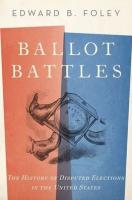
Ballot Battles
Ballot Battles
No customer reviews yet
ISBN 9780190865955
Oxford University Press, USA
The 2000 presidential race resulted in the highest-profile ballot battle in over a century. But it is far from the only American election determined by a handful of votes and marred by claims of fraud. Since the founding of the nation, violence frequently erupted as the votes were being counted, and more than a few elections produced manifestly unfair results. Despite America's claim to be the world's greatest democracy, its adherence to the basic tenets of democratic elections-the ability to count ballots accurately and fairly even when the stakes are high-has always been shaky. A rigged gubernatorial election in New York in 1792 nearly ended in calls for another revolution, and an 1899 gubernatorial race even resulted in an assassination. Though acts of violence have decreased in frequency over the past century, fairness and accuracy in ballot counting nonetheless remains a basic problem in American political life.
In Ballot Battles, Edward Foley presents a sweeping history of election controversies in the United States, tracing how their evolution generated legal precedents that ultimately transformed how we determine who wins and who loses. While weaving a narrative spanning over two centuries, Foley repeatedly returns to an originating event: because the Founding Fathers despised parties and never envisioned the emergence of a party system, they wrote a constitution that did not provide clear solutions for high-stakes and highly-contested elections in which two parties could pool resources against one another. Moreover, in the American political system that actually developed, politicians are beholden to the parties which they represent - and elected officials have typically had an outsized say in determining the outcomes of extremely close elections that involve recounts. This underlying structural problem, more than anything else, explains why intense ballot battles that leave one side feeling aggrieved will continue to occur for the foreseeable future.
American democracy has improved dramatically over the last two centuries. But the same cannot be said for the ways in which we determine who wins the very close races. From the founding until today, there has been little progress toward fixing the problem. Indeed, supporters of John Jay in 1792 and opponents of Lyndon Johnson in the 1948 Texas Senate race would find it easy to commiserate with Al Gore after the 2000 election. Ballot Battles is not only the first full chronicle of contested elections in the US. It also provides a powerful explanation of why the American election system has been-and remains-so ineffective at deciding the tightest races in a way that all sides will agree is fair.
"The 2000 presidential election, with its problems in Florida, was not the first major vote-counting controversy in the nation's history--nor the last. Ballot Battles traces the evolution of America's experience with these disputes, from 1776 to now, explaining why they have proved persistently troublesome and offering an institutional solution"--
The vitality of democracy depends on honest elections and a fair count of the ballots. Yet as Edward Foley demonstrates in this eye-opening study, many close elections at all levels of American government since 1792 have resulted in contested outcomes that violated one or both of these requirements. With no standard mechanism in place to determine fairly the winner of disputed elections, the instability and bitterness that has marked past elections will likely persist into the future, he predicts, unless we can come up with an accepted means of arbitrating disputed results.-James McPherson, George Henry Davis 1886 Professor of American History (Emeritus), Princeton University, and author of Battle Cry of Freedom
Ballot Battles isn't just the most comprehensive study of recounts to date; it's also a lens into our democracy. Foley pairs the clear-eyed perspective of an election lawyer with the idealism of a democratic theorist. He tells us not just who won and why, but who should have won and why we should care. The book is sure to become a touchstone for anyone interested in recounts and of interest to anyone interested in democracy.--Heather Gerken, J. Skelly Wright Professor of Law, Yale University
Professor Foley is the national expert on recounts, and his book is required reading for anyone who cares about the history and future of American election controversies. Those interested in the history will marvel at the detailed and dramatic retelling of contested election controversies stretching from the Founding Era to our own. For students of contemporary politics and election law, the book provides a sobering lesson on the entrenched features of the American constitutional system that make resolution of such controversies so difficult and unlikely to be solved any time soon.--Nathaniel Persily, James B. McClatchy Professor of Law, Stanford University
It's hard not to feel outrage and a little dread reading Edward Foley's retelling of ballot battles dating back to the nation's Founding. That's because, as Foley argues beautifully, American democracy lacks a fair, unbiased, non-partisan way to resolve contested elections. What will happen next time an election's outcome is in limbo? Ballot Battles makes a compelling argument that it could well be messy.--Tamara Keith, White House correspondent, NPR News
Foley's examination of the most recent, and best known, ballot battle in 2000 bookends his study of the phenomena...Foley's view of the 2000 controversy may seem counter-intuitive to many, but his exhaustive scholarship and powerful argumentation mean that it is a view that should be taken seriously.--Sean Ledwith, Reviews in History
About the author
Product details
BrandOxford University Press, USA
Pub dateJun 1, 2019
ISBN-100190865954
ISBN-139780190865955
Pages496
Dimensions9.2 × 6.1 × 1.1 in
Weight2 lb
Last updated 2021-06-21 06:43
$39.80
In stock — ships in 24 hours with free tracking
Delivery by Monday, September 7, 2026
Sign in to Add to Saved list
Fast checkout
Pay with Apple Pay or Google Pay when available.
Payment received
We are registering your order now. Please stay on this page while we redirect you to the confirmation page.
Free delivery on orders over $35.
15-day returns. Any reason.
Secure checkout. We never store card details.
Readers who bought this also bought
More from United States - General